
Carbon Reduction Plan
Introduction
Fincore Limited is fully cognizant of the fact that reduction of Greenhouse Gas (GHG) missions will result in significant benefits for the company, our customers, and the wider community as a whole. We are committed to achieving net Zero Emissions by 2050.
This plan with baseline year 2019 information, setting clear targets for reducing Greenhouse Gas (GHG) emissions over key timeframes and listing our planned projects to achieve carbon net zero by 2050.
This plan conforms to the requirements of Procurement Policy Note PPN06/21 as published by the Cabinet Office June 2021; “Taking Account of Carbon Reduction Plans in the procurement of major government contracts”, published in June 2021 and the supporting “Technical standard for the Completion of Carbon
Reduction Plans”. This document will be reviewed and updated annually and each revision will reflect changes in the company structure and specific projects undertaken to reduce our Carbon Emissions.
The Fincore financial year starts on 1st January and ends on 31st December. Our carbon plan has been aligned to this reporting cycle. The current period covered is 1st January 2022 to 31st December 2025.
Commitment to achieving Net Zero
Fincore Ltd is committed to achieving Net Zero emissions by 2050.
Fincore is a software publishing business. Because of the nature of our operations, our primary emphasis is on Scope 2 where any reduction has the biggest impact on our total carbon footprint. However, we also recognise the importance of reducing our Scope 1 and Scope 3 emissions to ensure steady progress towards achieving our Net Zero emissions target.
Reporting Standards and Scope
Fincore’s carbon footprint calculation is in line with the Greenhouse Gas Protocol Corporate Accounting and Reporting Standard.
Our current carbon footprint accounts for carbon emissions over which Fincore has direct financial control and Scope 3 emissions over which Fincore has direct influence.
The activities of related entities not under the direct control of Fincore Ltd are outside the scope of this report.
Baseline Emissions Footprint
| Baseline Year: 2019 |
| Additional Details relating to the Baseline Emissions calculations. |
| Our baseline emissions inventory includes all our measurable scope 1 and 2 emissions, together with a first estimate of our total scope 3 value chain emissions. We include all seven Kyoto Protocol GHG groups in our emissions footprint calculations where relevant. |
| Baseline year emissions: 2019 | |
| EMISSION | TOTAL (tCO2e) |
| Scope 1 | 0.50 |
| Scope 2 | 58.40 |
|
Scope 3 (Included sources) |
5.70 |
|
Total Emissions |
64.60 |
Previous Year Emissions Report
| Reporting Year: 2021 |
|
| Additional Details relating to the previous reporting period | |
| Throughout the reporting year 2021 the business was impacted by Covid-19 restrictions that were legislated by the UK Government. These restrictions included employees having to Work from Home and a sharp reduction in business travel and commuting. Even though we have not been able to collect data, it can be assumed that while offices were shut, there would be an increase in emissions by employees at home. While we have no means to measure the emissions, it may be assumed that emissions were reduced by 45% as compared to the previous year (2020). It can also be assumed that once restrictions are lifted and employees return to office, emission levels will rise again. | |
| EMISSION | TOTAL (tCO2e) |
| Scope 1 | 0.05 |
| Scope 2 | 21.29 |
|
Scope 3 (Included sources) |
0.85 |
| Total Emissions | 22.19 |
Previous Year Emissions Report
| Reporting Year: 2022 |
|
|
Additional Details relating to the current reporting period |
|
| In the reporting year 2022 the business emerged from Covid-19 restrictions after these were finally lifted at the end of January 2022. During the first half of the year, a cautious approach to return to work was adopted, with marginal increase of no more than 10% in office attendance. In the second half of 2022 a hybrid policy was formally adopted, with employees encouraged to attend office two to three days a week, resulting in average increase of 250% compared to the previous year of 2021. Business international travel increased by 200% compared to 2021, while there was an overall increase of 45% in waste disposal services. Energy consumption increased by about 25%, largely due to a slow ramp up of services after lockdown. | |
| EMISSION | TOTAL (tCO2e) |
| Scope 1 | 0.05 |
| Scope 2 | 26.61 |
|
Scope 3 (Included sources) |
2.98 |
| Total Emissions | 29.64 |
Previous Year Emissions Report
| Reporting Year: 2023 |
|
| Additional Details relating to the previous reporting period | |
| In the year 2023 business reverted to normal after all Covid restrictions were lifted. Fincore moved into new smaller downsized offices resulting in an overall reduction of office space by 55%. A hybrid policy of working was formalised permitting all staff to attend office two or three days a week and working from home for the rest of the time. Two directors stepped back from day-to-day management of operations, and a new CEO was appointed. The new office space was refurbished in a minimalistic style with no telephones, and a reduced number of photocopiers and printers. Old electronic equipment and servers were recycled, and all data was moved to cloud storage. Last but not the least, the company moved offices close to Moorgate and Liverpool Street Stations, which has resulted in a shorter commute for staff. Office was downsized in Q4 2023; therefore, the full impact of CO2 emission savings will be visible in 2024. |
|
| EMISSION | TOTAL (tCO2e) |
| Scope 1 | 0.04 |
| Scope 2 | 22.95 |
|
Scope 3 (Included sources) |
2.09 |
| Total Emissions | 25.08 |
Previous Year Emissions Report
| Reporting Year: 2024 |
|
| Additional Details relating to the previous reporting period | |
| In the Fincore Ltd Carbon Reduction Plan, Scope 2 emissions dropped from 22.95 tCO2e in 2023 to 4.13 tCO2e in 2024. Scope 3 Category 7* emissions have increased correspondingly to include employees working from home on average 3days a week (home working emissions) The overall reduction is attributable to several factors: In Q4 2023, Fincore moved to a smaller office, reducing energy needs for lighting, heating, and equipment. The full impact of this move was only realized in 2024, leading to lower electricity consumption. Staff attendance was limited to 2-3 days per week in the office. Less time in the office means less electricity used for lighting, computers, HVAC systems, etc. The officewas refurbishedwith minimalist design,fewer printers andphotocopiers, andno telephones. Alldatawasmovedtocloud storage,eliminating theneed for energy-intensive on-site servers. Fincore uses cloud providers like AWS and Azure, which are increasingly powered by renewable energy. This shift reduces the carbon intensity of digital operations. |
|
| EMISSION | TOTAL (tCO2e) |
| Scope 1 | 0.04 |
| Scope 2 | 4.13 |
|
Scope 3 (Included sources) |
8.90 |
| Total Emissions | 13.07 |
Current Year Emissions Report
| Reporting Year: 2025 |
|
| Additional Details relating to the previous reporting period | |
|
Throughout 2025, Fincore expects to maintain its established hybrid working model, with staff attending the office on average two to three days per week and working remotely for the remainder. This continued approach is projected to sustain reductions in office energy use while maintaining productivity and employee engagement. A further reduction in business travel is anticipated as the organisation increases its use of remote collaboration and video‑conferencing tools, including Microsoft Teams and WhatsApp. As a result, business travel emissions are projected to decrease by a further 10% compared with 2024. In addition, office electricity consumption is expected to fall by approximately 10% following the installation of motion‑sensor lighting and improved energy‑management controls. These measures reduce unnecessary lighting usage during periods of low or no |
|
| EMISSION | TOTAL (tCO2e) |
| Scope 1 | 0.04 |
| Scope 2 | 3.72 |
|
Scope 3 (Included sources) |
8.46 |
| Total Emissions | 12.22 |
Emissions Reduction Targets
In order to continue our progress to achieving Net Zero, we have adopted the following carbon reduction targets.
We aim to reduce:
- Scope 1 emissions to zero gradually in the period to 2050 but as rapidly as market options allow by incentivizing the use of net-zero fuel options, e.g., The current vehicle used for company business is a fully electric car. Any future vehicle procurement for company business will use carbon-neutral electric energy.
- Scope 2 emissions by making use of energy efficient appliances and office equipment. Further improving software efficiency through tuning in order to eliminate at least a further 15-20% of energy use for equivalent workloads over the next 10 years through the use of more efficient algorithms.
- Promoting remote work policy: This reduces commuting emissions significantly.
- Sustainable Procurement: Work with suppliers who have strong environmental policies. This includes everything from office supplies to cloud service providers.
- Employee Engagement: Encourage employees to adopt sustainable practices, such as using public transport, cycling, or walking to the office.
- Waste Reduction: Cut back on paper and implement a robust recycling program in the office. Ensure that all electronic waste is properly recycled.
- Cloud Computing: Moving data storage to the cloud can reduce emissions, especially if the cloud provider uses renewable energy.
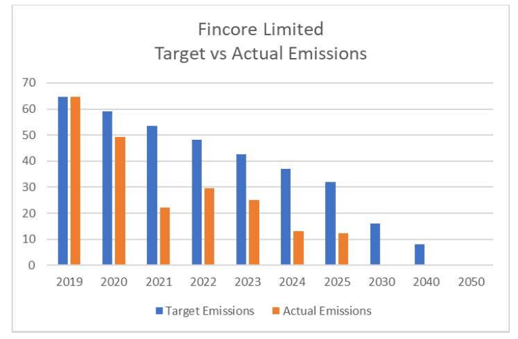
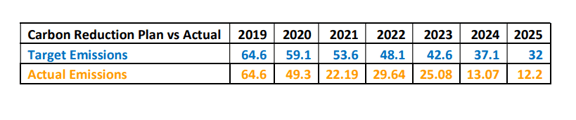
Fincore is already ahead of its projected target and near 50% below the baseline. We plan to continue to decrease carbon emissions over the next years to stay on track.
Carbon Reduction Projects
Completed Carbon Reduction Initiatives
The following environmental management measures and projects have been completed or implemented since the 2019 baseline.
- Reduction of business travel as a % of turnover and incentivisation of travel options with a lower carbon footprint such as rail travel, including reduction in international air travel.
- Restricting face-to-face business meetings to most essential and encouraging ever increasing use of online video conferencing tools, e.g. Microsoft Teams, Zoom, WhatsApp etc for business meetings.
- Reduction of carbon emissions from commuting through a more efficient mix of work from office/home. We have adopted a Hybrid model of working. Employees are now required to attend offices two to three days a week and work from home for the balance days.
- Performance improvements in our SaaS software to reduce energy use for equivalent workloads across different software products.
- Greater use of cloud services that have a lower carbon footprint than older data centers aiming for Net Zero by 2025.
- Fincore has already decommissioned its servers in off-site data centers and moved all data to cloud storage.
- Moving towards a totally paperless office, including e-signing.
- Downsizing the office space and, reducing the number of workstations & electronic equipment by over 50%. This includes no more use of telephones and reducing the number of printers/scanners and photocopiers.
Declaration and Sign Off
This Carbon Reduction Plan has been completed in accordance with PPN 06/21 and associated guidance and reporting standard for Carbon Reduction Plans.
Emissions have been reported and recorded in accordance with the published reporting standard for Carbon Reduction Plans and the GHG Reporting Protocol corporate standard1 and use of the appropriate Government emission conversion factors for greenhouse gas company reporting2.
Scope 1 and Scope 2 emissions have been reported in accordance with SECR requirements, and the required subset of Scope 3 emissions have been reported in accordance with the published reporting standard for Carbon Reduction Plans and the Corporate Value Chain (Scope 3) Standard3.
This Carbon Reduction Plan has been reviewed and signed off by the directors.
[1] https://ghgprotocol.org/corporate-standard
[2] https://www.gov.uk/government/collections/government-conversion-factors-for-company-reporting
[3] https://ghgprotocol.org/standards/scope-3-standard