
AI Enabled Data Quality: Moving from Automation to Intelligent Automation

Company Profile
|
Industry: |
Financial Services |
|
Client: |
A major European financial institution, with clients and partners across Europe. |
|
Use Case: |
How Finworks is helping a financial services organisation use AI to augment existing automation, accelerate analysis and keep human accountability at the centre of data quality decisions. |
Introduction:
This case study demonstrates four main points of interest:
| Discover how a large European financial institution is moving from rules-based data quality automation to AI-enabled intelligent automation | |
| See how AI can investigate data quality exceptions, analyse historical actions and provide additional context, helping teams reach informed decisions faster | |
| Explore how AI augments existing systems without replacing established controls, keeping human judgement, data ownership and accountability at the centre |
|
| Learn how a practical, incremental approach to AI adoption can improve operational efficiency, reduce manual effort and create opportunities for wider automation in regulated environments |
The Challenge:
Making existing automation more intelligent
For financial services organisations, data quality is critical. Trusted data underpins operational processes, decisions, products, services, and reporting, while responsibility for that data remains with the organisations that own and provide it.
Our client, a large European financial institution, already had automated data quality monitoring in place. A rules-based engine could identify potential issues and exceptions according to predefined validation criteria reducing the need for purely manual checking.
The data quality automation still required human intervention to determine why the data is wrong, investigate the wider context or decide what should happen next. To investigate the potential exceptions teams had to research supporting information, consider the available evidence, and make a decision before the issue could be resolved.
The opportunity was to introduce AI without replacing the existing controls or removing human accountability.
The question was:
How could AI make existing data quality processes faster, more intelligent and more useful to the people responsible for making the final decision?
The Approach:
AI as an augmentation layer
The project was developed collaboratively between Finworks and our client.
The client has an established focus on innovation and was prepared to invest in exploring how emerging technologies could improve existing processes. Finworks brought its technical expertise and understanding of the organisation's systems, while business teams helped identify where AI could deliver practical value.
Rather than attempting a wholesale transformation, the approach was incremental.
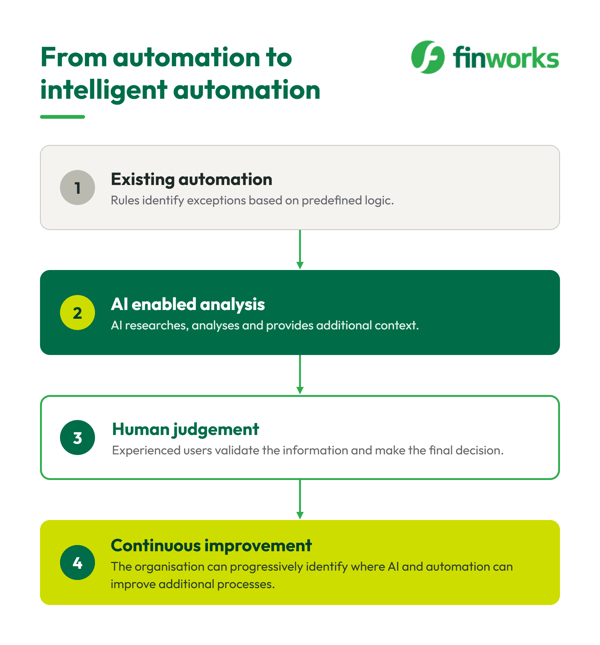
The existing rules-based engine remained at the heart of the process. AI was introduced as an additional intelligence layer, capable of researching and analysing the exceptions identified by existing automation.
This creates a clear division of responsibility:
Automation identifies. AI investigates. People decide.
The AI capability can research relevant information, including appropriate third-party information, analyse the available context and provide the user with an informed analysis or suggestion.
The final decision remains with the human.
This distinction is particularly important in a regulated environment, where data ownership and accountability cannot simply be transferred to an AI system. The organisation's policies and governance requirements determine who remains responsible for the data and the decisions made about it.
The Solution:
Adding intelligence to an established process
The data management solution combines existing rules-based automation with AI-enabled analysis.
At a high level, the enhanced process works in five stages:
01 — Data enters the existing process
Data continues to pass through established systems and controls.
02 — Rules identify potential issues
The existing rules-based engine performs automated validation and identifies exceptions.
03 — AI investigates the exception
AI can research relevant information and analyse the circumstances surrounding the potential issue, including historical actions.
04 — The user receives additional context
Instead of starting the investigation from scratch, the user receives analysis that can help them understand the exception and assess the available evidence.
05 — The human makes the decision
The appropriate person retains responsibility for validating the information and deciding what action should be taken.
The result is not autonomous decision-making. It is augmented decision-making.
The rules-based engine is effective at applying predefined logic consistently. AI adds the ability to investigate and analyse information in a broader context, helping users understand an exception without having to undertake all of the research themselves. It learns from decisions taken historically about such exceptions.
As well as helping analyse data quality exceptions, AI can support the creation and enhancement of automation itself, potentially accelerating activities across business, technical, operational and documentation processes.
This is the move from automation to intelligent automation.
Why the human remains central
The project is deliberately designed around human-AI collaboration.
AI is not being positioned as a replacement for the people responsible for data quality. Instead, it provides additional analytical capability that helps those people work more efficiently.
For example, when an exception requires investigation, a member of the team may previously have needed to locate relevant background information, review multiple sources and analyse the available evidence before reaching a decision.
AI can perform much of that research and analysis far more quickly.
The result is not an automated decision. It is a better-informed human decision.
This approach can help:
- reduce the time spent researching individual exceptions;
- provide broader contextual analysis;
- reduce the effort associated with false positives;
- support more consistent decision-making;
- make better use of existing human expertise; and
- increase the value of existing rules-based automation.
The principle is simple: use AI to make people better at the work they remain accountable for.
Designed for a regulated environment
The implementation deliberately avoids treating AI as a black-box replacement for established controls.
Human accountability remains central. The organisation's policies determine who owns the data and who is responsible for decisions relating to it. AI therefore supports the decision-making process without taking ownership of the decision itself.
This approach also reflects the reality of introducing new technology into a regulated environment.
Building confidence is as important as building the technology.
The project is therefore being introduced incrementally, allowing users to gain experience with the capability and understand how AI-generated analysis can support their existing responsibilities.
The Outcome:
Faster research. Broader analysis. Better supported decisions.
The AI capability is at acceptance stage, with production go-live expected shortly afterwards. The organisation's response had been positive, with strong enthusiasm for the new capability.
At this early stage, the project does not yet have a validated set of quantitative performance measures that could responsibly be attributed to the AI implementation.
The financial institution does, however, operate against defined service levels, providing a clear basis for measuring the longer-term impact.
The expectation is that intelligent analysis will help teams reach the required outcome more quickly and with less effort. Where activities operate on recurring cycles, the time taken to complete those activities can also provide a useful measure of improvement.
Future measurement could therefore focus on areas such as:
- time taken to investigate and resolve data quality exceptions;
- compliance with defined service levels;
- volume of manual research required;
- consistency of decisions;
- adoption of the AI capability across relevant teams; and
- the overall effort required to complete recurring processes.
Adoption matters as much as technology
The project has also highlighted an important reality of AI adoption: introducing the technology is only part of the transformation.
Some users will embrace new capabilities immediately. Others may be cautious about changing established ways of working or may need time to build confidence in AI generated analysis.
That makes adoption and change management important parts of the journey.
The technology may make a task significantly faster for an individual user, but the wider organisational benefit depends on people being willing and able to incorporate the capability into their everyday work.
What's next?
Extending AI across the technology lifecycle
The work forms part of a wider approach to applying AI across technology and operational processes.
Finworks is also using AI internally to augment the skills and experience of its development and support teams.
For example, AI can help specialists research the causes of an issue, investigate potential solutions and analyse a much broader range of information in a shorter period of time.
Importantly, this remains a controlled process. AI is not permitted to independently deploy code. Experienced specialists guide the investigation, assess the results and use their own knowledge and judgement to determine the appropriate action.
Looking further ahead, autonomous agents could potentially support controlled activities such as regression testing, integration testing, penetration testing and continuous production monitoring.
These are future opportunities rather than capabilities being claimed as part of the current implementation. The objective is to use increasingly intelligent automation to identify issues earlier, improve stability and focus human expertise where it provides the greatest value.
The Finworks perspective:
AI doesn't have to replace what already works
For organisations with significant investment in established systems and automation, AI does not necessarily mean starting again.
The case study demonstrates a different approach. Existing automation continues to provide the foundation and AI adds intelligence around it but people retain accountability and control. The approach provides a practical path towards AI adoption that builds on what is already working rather than attempting to replace it.
The principle is simple:
Use AI to enhance the process, use automation to improve consistency, and keep people accountable for the decisions that matter.
For financial services organisations, that combination can provide a more controlled and practical route from rules-based automation towards intelligent automation.
Looking to make AI practical?
Finworks helps organisations explore how AI can be introduced into existing data, workflow and operational processes with governance, security and human accountability built into the approach.
Talk to Finworks about your AI and automation requirements.
"Finworks demonstrated an exceptional commitment towards the maintenance of the application and very high, far beyond normal, flexibility and adaptability when answering to requests”
"Finworks demonstrated extreme professionalism, skills and flexibility during the project, allowing for a record go-live timeline. Finworks continued to show the same level of dedication during the subsequent maintenance phase"
"Finworks was proactively highlighting the need to change to improve the system and that resulted in what we have now, that is a system that has been live for almost 2 years now without a big malfunction … and that says a lot about the quality of the product"