
From AI Pilot to Public Service
The Workflow Foundations Government Needs to Scale AI
Across government, the hardest part of adopting AI is rarely the model itself. It is proving the organisation can run it in a way people can trust: who signs off when something goes wrong, where that decision is recorded, and how the reasoning can be reviewed months later.
A pilot can work in a sandbox with informal oversight and still go no further, because the escalation path, audit trail, and accountability a live service needs were never built. This page explains where that gap appears, what a workflow must have in place before AI can move from a working demo to a live service, and what it costs a department when that step is missed.
Table of Contents
Section 1: Why AI Stalls Without a Governed Workflow – the Inside Story
Section 2: Where AI Pilots Stall
Section 3: The AI Workflow Maturity Curve
Section 4: What Has to Be True Before You Scale
Section 5: Why This Is a Finworks Problem to Solve
Section 6: What This Looks Like Off the Page
Section 7: Discover What A Governed AI Workflow Look Like For Your Department


Why AI Stalls Without a Governed Workflow: the Inside Story
Somewhere in most government departments, an AI pilot has already worked. It classified the documents correctly. It flagged the right cases. It did, technically, what it was built to do.
And then it stopped there.
Not because the model failed but because nobody had built the thing the model needed to run inside: a workflow that could catch its output, route it to the right person, log the decision, and stand behind it if anyone ever asked to see the reasoning. The pilot proved the technology. It never had to prove the process.
That gap, between what a model can do in a controlled environment and what a department can run at scale, is where most public sector AI stalls. Not in a lab, but in the handover from pilot to practice.
Every department that has piloted AI has proven the model works. Almost none have proven their organisation can run it. If you're the team or decision maker who has to take AI from a working demo to a live service, defend the business case, or explain the timeline to a minister, this is usually the gap that you have to be ready for. In this article, we explore the AI gap, what a governed workflow needs to address it, and what it looks like once it's built.
Where AI Pilots Stall
The explanation almost always starts with the technology. The model needs retraining. The data needs cleaning. The infrastructure needs upgrading. Sometimes that's true. It's rarely the full story.
In a September 2025 study of more than 1,250 companies, BCG found that only 5% were getting substantial value from their AI investments. Government's own workforce data tells a similar story: a February 2026 survey of UK public servants found that 63% say they know "a little" or "nothing at all" about AI, a gap the report ties directly to AI use depending on local initiative rather than any systemic, governed rollout.
It is often the case that not enough project time focuses on the workflow, and it tends to break down in three predictable places.
|
1. Governance gets retrofitted, not designed in |
A pilot runs in a sandbox with informal oversight, someone keeping half an eye on the outputs. When it's time to go live, that informal oversight has to become a formal one: defined escalation points, a named accountable officer, an audit trail that holds up to scrutiny. Departments that leave this until after the pilot succeeds are building governance under pressure, which is the hardest way to build it.
|
|
2. Nobody designed for disagreement |
Most AI rollouts carefully design what happens when the model is right. Few design what happens when a caseworker overrides it. Who gets notified? Does the override get logged with the same rigour as an approval? Whether that judgement call becomes part of the case record or quietly disappears into a notes field nobody reads again is an important distinction. |
|
3. Scale exposes what small numbers hide |
A manual step that copes with 50 cases a month will not cope with 5,000. It will simply fail, faster and more visibly, once AI starts pushing more cases through the same door. The workflow doesn't get a pass because the intake got smarter. If anything, it gets tested harder. This isn't only a Finworks view either: the National Audit Office made a related point just this year, warning that legacy IT and poor-quality cost data, not a shortage of ambition, are what's actually holding back AI's potential in government's own finance function. |
None of this is surprising, once you notice the incentives. A successful pilot gets a demo, a slide, sometimes a ministerial mention. A governed workflow often is not acknowledged. It’s unglamorous by design, and the success metric of "we didn't have an incident" is hard to quantify. Departments don't skip it because they don't understand it. They skip it because nothing rewards building it early, only avoiding it late.
None of this is a reason to slow down on AI. It's a reason to be honest about what "ready" means before scaling past the pilot.
Data Privacy
Focus:
Data privacy primarily concerns the protection of individuals' personal information and their right to control how their data is collected, used, and shared. It revolves around respecting the privacy of data subjects.
Rights and Consent:
Data privacy emphasises obtaining consent from individuals before collecting their data. It also allows individuals to access their data, correct inaccuracies, and request its deletion.
Compliance:
Data privacy regulations define specific requirements for handling personal data. Compliance involves respecting these legal frameworks and ensuring that individuals' data rights are upheld.
Examples:
Data privacy concerns practices like obtaining explicit consent for marketing emails, allowing users to review and delete their online profiles, and providing data collection and usage transparency.
Data Security
Focus:
Data security is primarily concerned with protecting data from unauthorised access, breaches, or leaks, regardless of whether the data is personal or not. It encompasses broader aspects of safeguarding data from various threats.
Protection Measures:
Data security involves implementing various technical and organisational measures that ensure data confidentiality, integrity, and availability. This includes encryption, access controls, firewalls, and intrusion detection systems.
Risk Management:
Data security identifies potential vulnerabilities and threats, assesses risks, and implements mitigation strategies to reduce and prevent the impact of security incidents.
Examples:
Data security practices include securing databases with strong passwords, encrypting sensitive files, conducting regular security audits, and training employees on security best practices.
The AI Workflow Maturity Curve
Most conversations about AI readiness in government still centre on the data: is it clean, is it governed, does it have an owner? That matters, but it answers only half the question. The other half is whether the workflow around the AI decision is mature enough to carry it at scale.
We think about that maturity in four stages.
Ad hoc. Pilots exist somewhere in the organisation, but nobody could say exactly how many, or what happens to them once the demo ends. Oversight is informal and personal, whoever happens to be watching that day.
Piloted. One use case works, in a controlled environment, with a small team paying close attention. There's no defined route from this stage to a live service, so the pilot often just stays a pilot, sometimes for years.
Governed. The workflow around the AI decision now exists on purpose. Escalation points are defined. Every action is logged as part of the case record, not bolted on afterwards. A named officer is accountable for the outcome, and there's a real answer if an auditor, an inspectorate, or an FOI request asks for it.
Scaled. The same governed workflow now runs across multiple services, not just the original pilot. Scaling stopped being a leap of faith because the mechanism that made it trustworthy at stage three doesn't need reinventing at stage four, it just needs repeating.
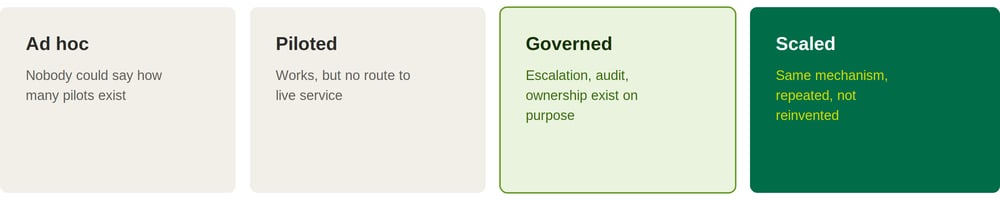
Most departments we talk to can place themselves on this curve within a minute of hearing it described. Very few land at "Governed" before they attempt to scale, which is exactly why so many AI initiatives stall at the pilot stage rather than failing outright. They aren't broken. They're just missing the stage that makes the next one possible.
What Has to Be True Before You Scale
Reaching "Governed" isn't a matter of writing more policy. It's a matter of building specific things into the workflow itself.
Auditable by design
Every AI-assisted decision should be routed, logged and time-stamped as part of the case record from the outset, not reconstructed after the fact when someone asks for it. Auditability that has to be assembled retrospectively rarely survives real scrutiny.
Human accountability with a clear shape
AI recommends; a named person decides. That only works if the workflow has configurable escalation and sign-off points built in, so the department can say precisely who was accountable for which decision, and why.
Low-code, so governance can keep pace with policy
Scrutiny requirements change. Ministerial priorities shift. A workflow that needs a development cycle every time a sign-off rule changes will always be governing yesterday's requirements. A low-code platform lets departments reconfigure the workflow themselves.
Proven under real operational pressure
Governance that only works in calm conditions isn't governance, it's a hope. The test is whether it holds during a caseload spike, a staffing gap, or a live FOI request, not whether it looks good in a policy document.
Why This Is a Finworks Problem to Solve
There's a fair question sitting underneath all of this: why believe Finworks specifically knows how to close this gap, rather than any other workflow vendor making a similar argument right now.
Three reasons, stated plainly. Finworks builds exclusively for UK public sector case management, not a general enterprise platform with a government use case added on, so the assumptions built into the product, OFFICIAL SENSITIVE handling, FOI-ready audit trails, and ministerial sign-off patterns, match how government actually works rather than how a private-sector workflow happens to translate. It's low-code by design, so a department isn't waiting on a vendor's development cycle every time a sign-off rule or scrutiny requirement changes; governance can move at the same pace as policy. And it's listed on G-Cloud 15 and DOS 7, so getting from this page to a live conversation doesn't require a tender built from scratch.
None of that is a claim about being better at AI than whichever model your department is already piloting with. It's a claim about what has to exist around that model, which is a workflow question, and it happens to be the one Finworks has extensive history with.
What This Looks Like Off the Page
Building a trusted platform often is not always heralded. Nobody puts "we built a reliable, unremarkable audit trail" in a highlights reel. But it's usually the difference between a department still running its system in three years, and one explaining in a board paper why the pilot never went anywhere.
Finworks worked with a UK Government department that had exactly the discreet problem this page is about, just without AI in the picture yet. Case building, legal and ministerial review, running on thousands of Word documents and hand-built spreadsheets. Not a technology failure. A workflow that had quietly become the department's real system of record, without anyone designing it to be one.
What was implemented wasn't dramatic either: a standardised workflow, automated notifications instead of manual chasing, a secure audit trail on every action, role-based permissions, and exports reliable enough to publish straight to GOV.UK. The department's own description of it: "The Finworks Platform product has allowed our department to move from the world of thousands of Word documents and manually created Excel spreadsheets to modern information management."
That's what a governed workflow looks like once it's built. Not a headline. A department that stopped needing to explain why the numbers didn't add up.
Discover What A Governed AI Workflow Look Like For Your Department
None of this is an argument against AI in government. It's an argument for finishing the part of the work that doesn't show up in a pilot demo.
The departments that will still be running their AI-assisted services in five years won't be the ones with the most advanced model. They'll be the ones who treated the workflow around it as seriously as the technology itself. The teams who knew, case by case, who decided what and why, and who built that discipline before the caseload made it unavoidable.
Finworks can help help you with the hard part. It's worth getting the workflow right before you scale, not after.