
Secure and Scalable Case and Workflow Management for the Public Sector
Finworks’ approach to secure and governed case management
Scaling services in an era of rising demand
Public-sector organisations are navigating unprecedented pressure: citizen expectations are rising, regulatory frameworks are tightening, and the margin for error is shrinking.
Many organisations are delivering critical services on platforms designed to cope, not to scale. As pressure builds, gaps in performance, governance, and data protection appear which directly impact how services are delivered, monitored, and improved.
Case and Workflow Management: Implications Beyond Operations
It directly impacts:
|
Protection of sensitive citizen and operational data |
|
|
Audit readiness and regulatory compliance |
|
|
Service continuity under pressure |
|
|
Public trust in digital services |
When workflows are fragmented or poorly governed, risk accumulates quietly. Scaling then becomes reactive rather than controlled.
The right approach doesn't just manage workflows, it builds confidence among citizens, stakeholders, and oversight bodies.
Scenario 1: Local Authority Social Services
A local authority is managing safeguarding and adult social care cases across multiple teams, external providers, and partner agencies.
What’s at stake
1. Highly sensitive citizen data
2. Statutory response times
3. Legal and audit scrutiny
4. Public confidence in service decisions
Where things go wrong
When workflows are fragmented across spreadsheets, email chains, and legacy systems:
A) Case data is duplicated or inconsistently updated
B) Audit trails are incomplete or hard to reconstruct
C) Ownership of decisions becomes unclear
D) Staff rely on manual checks to manage risk
As demand increases, pressure builds on individuals rather than systems. Risk accumulates quietly until it surfaces through missed deadlines, compliance failures, or serious case reviews.
Why governed workflows matter
Well-defined workflows with embedded governance create consistency in how decisions are made and recorded, improve audit readiness without relying on manual effort, and allow regulatory services to scale in a predictable and controlled way. This reduces operational risk and strengthens confidence in outcomes across the organisation.
Scenario 2: Central Government Regulatory Body
A regulatory department oversees licensing, inspections, and enforcement across a national programme involving multiple internal teams and external stakeholders.
What’s at stake
1. Regulatory compliance
2. Consistency of decisions
3. Transparency under scrutiny
4. Operational resilience
Where things go wrong
As volumes grow and regulations evolve:
A) Processes diverge across teams
B) Data moves between systems without consistent controls
C) Reporting and audit preparation becomes resource-heavy
D) Changes are made reactively to address incidents
Scaling becomes a series of workarounds rather than a controlled process.
Why governed workflows matter
Well-defined workflows with embedded governance standardise how decisions are made and recorded, improve audit readiness without relying on manual effort, and allow regulatory services to scale in a predictable way. This reduces operational risk and strengthens confidence in outcomes.
Legacy Systems Weren't Build for Modern Demands
Most challenges stem from the same root cause.
Security, governance, and scalability were added over time rather than designed in from the start.
This often leads to:
|
|
Manual workarounds to keep services running |
|
|
Inconsistent security controls across workflows |
|
|
Limited end-to-end visibility |
|
|
Governance applied after issues arise |
Governance-First Design to Scale Case and Workflow Management
Finworks supports public-sector organisations with case and workflow management designed to scale securely.
We believe modern case and workflow management should be built around clear accountability: who owns each step, how data moves through the system, and how controls stay consistent at any scale. Enabling teams to focus on delivering better outcomes.
Our approach focuses on:
|
|
Security embedded into multiple levels including workflows and data sharing |
|
|
Clear ownership and accountability at every stage |
|
|
Structured and monitored processes that remain adaptable as demand grows |
This supports controlled evolution of platforms without disrupting live services.
Scale Without Adding Risk. Adapt Without Disrupting.
Public-sector systems are expected to scale, adapt, and remain secure at the same time. In practice, this is where many platforms struggle. Risk accumulates through fragmented workflows, manual controls, and governance that was never designed to operate at scale.
Finworks brings deep experience delivering case and workflow platforms in complex, regulated public-sector environments. We understand where risk typically emerges as services scale, how governance can break down in live systems, and what it takes to modernise without disrupting delivery or weakening control.
By embedding governance and security directly into workflows, we help organisations move beyond short-term fixes and build platforms that scale predictably, withstand scrutiny, and continue to earn trust.
Whether you're untangling legacy workflows, preparing for an audit, or scaling a new digital service, Finworks can help you move from uncertainty to operational clarity. Talk to our experts about navigating securely at scale.
Why Governance Readiness Matters?
Too many public sector organisations believe their systems are compliant until they’re asked to prove it.
- Until a partner mishandles sensitive case data
- Until a decision is questioned and no one can trace who made it
- Until a citizen says: “Why did this happen to me?”
What looked like a functioning, compliant service suddenly becomes a reputational and operational risk.
Not because people weren’t working hard but because governance wasn’t built in.
At Finworks, we developed a comprehensive governance checklist designed to support our partners in navigating government requirements, strengthening compliance, and fostering transparent, accountable collaboration.
This Secure and Governed Case Management Checklist is a practical tool for public sector teams to:
- Reflect on how governance is actually enforced in day-to-day workflows
- Identify areas where risk may be growing quietly from ownership gaps to audit blind spots
- Align leadership, delivery, and information governance teams on what to prioritise next
It covers six essential areas:
Ownership. Controls. Visibility. Auditability. Resilience. Scalability.
Whether you’re managing legacy systems or scaling new services, this checklist helps you surface what’s being overlooked and take meaningful action. It’s not just about asking the right questions. It’s about making sure your case management platform is ready for what’s coming next.
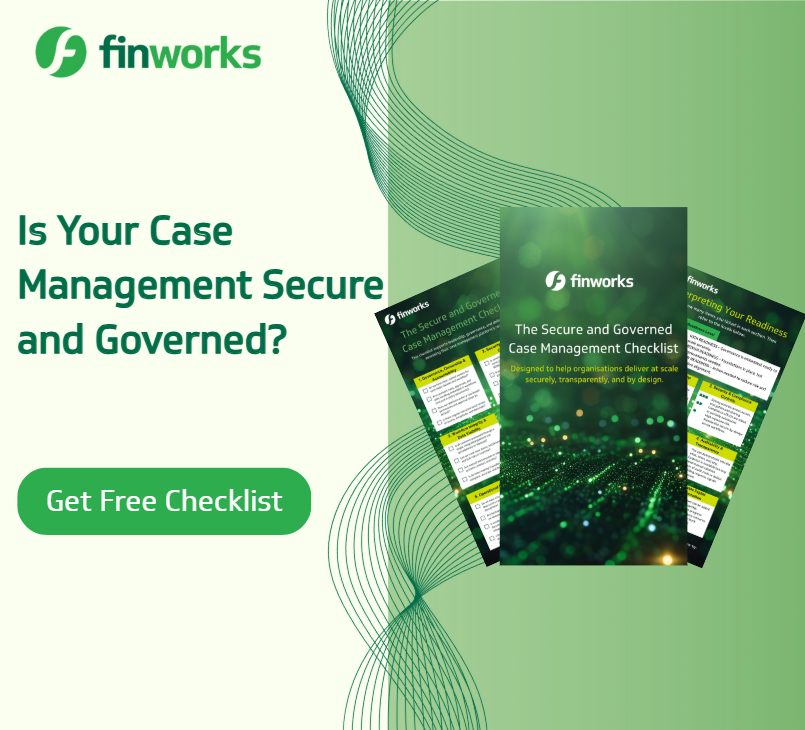
Download the Secure and Governed Case Management Checklist
Resources for modernising case & workflow management
Practical guidance and perspectives to help departments, agencies, and public-sector teams
navigate the challenges of scaling services securely and effectively.